

Why Stories Matter
It's never “just a movie.”

One of the most common responses to the controversy surrounding The Odyssey has been some variation of the same question:
Why do you care so much?
Some people online have been calling me obsessed, but for the past week I have been going after The Odyssey hard with memes, commentary, and opinions surrounding this travesty of a movie.
A large portion of my comment section is filled with people who agree with me.
But there are always a few who say:
“Hey, bro, why don’t you just go along with it? It’s just a movie.”
Why argue about the costumes? Why care about what Hollywood does with some story written thousands of years ago?
Here’s why:
BECAUSE STORIES PLAY A MEANINGFUL ROLE IN SOCIETY.
And as someone who has spent years online and built a business through social media, I can tell you that stories are not merely meaningless pieces of content that briefly entertain or distract us.
Stories are one of the primary ways a civilization communicates its values.
They teach people what courage looks like, what deserves to be defended, what should be rejected, and what kind of person deserves to be admired.
Long before most people study Plato, Aristotle, theology, history, or any of the great philosophers, they encounter stories.
And stories are one of the most powerful methods of teaching.
A child does not begin by reading the dictionary’s technical definition of courage.
He learns courage by watching someone face danger despite being afraid because stories place abstract values into human form.
This is why people should care about what Hollywood does with The Odyssey. It is not merely another action franchise or disposable streaming series. Homer’s Iliad and Odyssey are considered among the most influential works in the history of Western civilization.
When you inherit a story like that, you inherit something much larger than intellectual property.
You inherit part of a civilization’s memory.
Stories Built Western Civilization
Western civilization was built through stories.
The Greeks told stories about Achilles, Hector, Odysseus, and the tragic consequences of pride.
The Romans told stories about duty, sacrifice, citizenship, and the founding of their civilization.
The biblical tradition gave us stories of creation, exile, sin, sacrifice, redemption, death, resurrection, saints, martyrs, sinners, and converts.
Long before philosophy was written down and distributed to ordinary people, civilizations passed wisdom from one generation to the next through myths, poems, songs, parables, public recitations, and family histories. The Homeric epics themselves emerged from an oral tradition that was recited and reworked across generations.
Jesus Himself frequently taught through stories.
Matthew’s Gospel tells us:
“Jesus spoke all these things to the crowd in parables; he did not say anything to them without using a parable.”
That is not an insignificant...
Jesus could have communicated every lesson through abstract theological explanations. Instead, He spoke about seeds, vineyards, servants, shepherds, sons, weddings, debts, and lost sheep.
He placed eternal truths inside stories that ordinary people could understand, remember, and repeat.
AND HE WAS UNDERSTOOD!
Because stories communicate truths that cannot always be reduced to some cheap slogan.
You can tell a person that courage matters.
But a story allows him to experience what courage costs.
G.K. Chesterton explained this beautifully when he wrote:
“What fairy tales give the child is his first clear idea of the possible defeat of bogey.”
In other words, stories do not merely tell children that dragons exist.
Children already understand that the world contains danger, fear, and evil.
Stories teach them that dragons can be defeated.
That is what great stories do. They dramatize the struggle required to live well, and they inspire us to become stronger human beings.
That is also why great stories survive.
Yes, The Odyssey emerged from an ancient world nearly 3,000 years ago. But its human conflicts remain familiar to modern people today.
That is why stories matter.
Why The Odyssey Matters
The Odyssey is often described as an adventure story about a man attempting to return home after war.
That description is technically accurate, but it misses the deeper meaning of the story.
Odysseus is not simply a man traveling from one location to another.
He is attempting to return to the place where he ultimately belongs and to the people he loves and toward whom he has obligations.
He is a husband trying to return to his wife.
He is a father trying to return to his son.
He is a king trying to return to his kingdom.
Along the way, he encounters sirens, monsters, gods, pleasures, distractions, and countless opportunities to abandon the journey.
Again and again, he is offered reasons to forget Ithaca.
That is the temptation every man faces.
Temptation rarely appears as something obviously evil. If it did, most men would immediately avoid it.
Instead, temptation usually appears as comfort.
It offers relief from suffering. It whispers that you have already sacrificed enough. It tells you that you deserve to stop carrying the responsibilities placed upon you.
Odysseus could remain somewhere else.
He could accept pleasure, rest, comfort, or even immortality. He could forget the difficult road home and abandon the people waiting for him.
BUT ODYSSEUS IS CALLED TO SOMETHING GREATER.
His home continues calling him.
His journey requires endurance—a virtue every generation needs.
Meanwhile, his household has fallen into disorder.
Penelope is surrounded by suitors attempting to replace her husband. Telemachus is growing into manhood without his father. Men who did not build Odysseus’s household are consuming its wealth, violating its order, and attempting to seize his inheritance.
They consume what they did not create.
They demand what they did not earn.
They occupy a household that does not belong to them.
DOES THIS SOUND FAMILIAR?
This is not simply a story about personal survival.
It is a story every modern man should read today.
Odysseus is not perfect. He is proud, flawed, cunning, and frequently responsible for creating his own problems. But that is part of why the story remains human.
He is not a flawless superhero floating above ordinary temptation.
He is a man struggling to fulfill his obligations while being repeatedly pulled away from them.
The deeper story is about restoration.
A husband returns to his wife.
A father returns to his son.
A king returns to his kingdom.
A household that has been invaded and corrupted is reclaimed.
This is the moral architecture of The Odyssey: duty, home, temptation, endurance, inheritance, fatherhood, marriage, and restoration.
You can modernize the presentation. You can change costumes, condense events, rearrange scenes, or interpret individual characters differently.
But when you alter what the audience is supposed to admire, you are no longer making a superficial change.
You are changing the meaning of the story.
If duty becomes oppression, the meaning changes.
If faithfulness becomes foolishness, the meaning changes.
If fatherhood becomes irrelevant, the meaning changes.
If order becomes evil and disorder is presented as liberation, the meaning changes.
At that point, you are not merely adapting the original story.
You are using the name and reputation of the original to tell a completely different one.
“But Stories Have Always Been Adapted”
George Orwell understood the connection between controlling stories, controlling memory, and controlling a society:
“Who controls the past controls the future: who controls the present controls the past.”
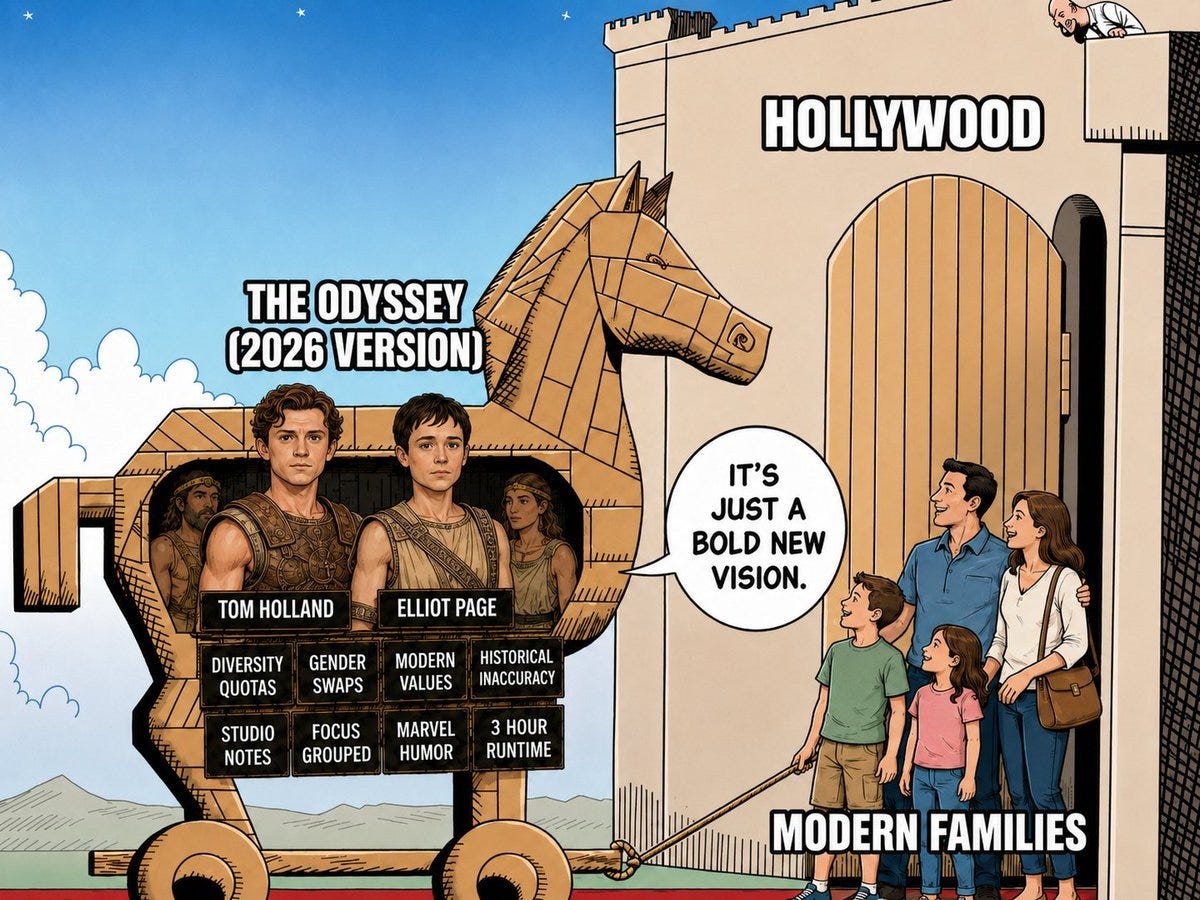
The predictable objection is that stories have always been retold.
That is true.
Ancient myths have been adapted for thousands of years. Shakespeare borrowed existing plots. Artists reinterpret characters, and filmmakers must make creative decisions.
No adaptation should be expected to reproduce every sentence, detail, or cultural assumption from its source material exactly.
A film does not have to resemble a museum exhibit to respect the original story.
BUT THE PROBLEM IS CONTEMPT.
Nolan described his objective this way:
“I wanted to tell it in a fresh and modern way, to make it as accessible for a modern audience as it was for Homer’s.”
There is a difference between translating an old story for a new audience and treating that story as something primitive that must be corrected by modern people.
A thoughtful adaptation asks:
What made this story survive?
What permanent truth is being communicated?
How can we present that truth in a way that moves a modern audience?
A contemptuous adaptation asks:
How can we use this familiar title to promote our own values?
THAT DISTINCTION MATTERS.
A modern filmmaker may have the legal right to do whatever he wants with a story in the public domain but the audience has the cultural right to reject what he does with it. But caring about that does not make people unsophisticated.
It means they understand that these stories are part of something larger than one director, one studio, or one movie.
Stories are part of our inheritance.
Why Stories Matter
A society that forgets its stories loses memory.
It loses a common language through which people can understand courage, sacrifice, betrayal, temptation, justice, and duty.
Without shared stories, generations struggle to communicate with one another.
The symbols that once united people disappear. The names and events that once carried meaning become obscure. Citizens begin to experience themselves not as members of an inherited civilization but as disconnected individuals who arrived from nowhere.
When people no longer know the stories of their civilization, they also lose the ability to compare the present with the past.
Which is why every modern generation begins to believe it is the first generation to encounter pride, corruption, tyranny, temptation, or disorder.
The disappearance of inherited stories does not create a neutral population.
It creates a vacuum.
And that vacuum will always be filled by someone.
It will be filled by corporations, advertisers, celebrities, political movements, algorithms, and institutions that have every incentive to give people a new identity and tell them what they should value.
A child who is not given heroes will not grow up without heroes.
He will simply be given different ones.
That is why stories matter not only to civilizations but also important to families.
Children need to hear how their grandparents lived. They need to understand what their parents struggled through. They need to know where their family came from, what it believes, what it has overcome, and what kind of people they are expected to become.
Those family stories create identity.
They tell a child:
You came from somewhere. You belong to someone.
Something was built before you arrived, and one day you will be responsible for carrying it forward.
That is inheritance in its deepest form.
We Need More People Telling Their Own Stories
For most of the twentieth century, a relatively small number of institutions controlled which stories reached a mass audience.
Movie studios decided which stories became films.
Newspapers decided which events mattered and how those events should be interpreted.
BUT YOU ARE THE MEDIA NOW!
Take this role seriously because the system gave a small group of cultural gatekeepers enormous power.
But the internet shattered much of that control.
Today, an ordinary person can publish an essay, record a podcast, build a newsletter, create a video, write a book, or develop an audience without first receiving permission from a Hollywood studio, publishing executive, television producer, or newspaper editor.
That is one of the greatest opportunities of our time.
But it also comes with a responsibility.
It is not enough to complain that Hollywood tells bad stories.
We have to tell better ones.
It is not enough to complain that institutions misrepresent our values.
We have to communicate those values ourselves.
It is not enough to complain that the stories of our families, communities, faith, and civilization are being forgotten.
IT IS UP TO YOU TO PRESERVE THEM.
Build a Platform for Your Ideas
This is one of the reasons I believe so strongly in platforms such as Substack.
It can become the home of your ideas, your experiences, your expertise, and the stories you want to tell.
Unlike a social media post that disappears from the timeline within hours, a newsletter creates a body of work.
It gives people a place to find you, understand what you believe, and follow your thinking over time.
But many creators do not know how to position their Substack, improve their writing, organize their ideas, or turn occasional readers into a genuine community.
Recently, The Culturist and I hosted a live call in which we reviewed Substack accounts and showed creators what they could improve LIVE.
At the end of this month, I am giving the complete recording of that session to every PAID subscriber.
A paid subscription is only $8 per month, which works out to roughly 26 cents per day.
You can also subscribe for $80 per year, which works out to approximately 22 cents per day and saves you $16 compared with paying monthly for a full year.
Click below to become a paid subscriber and support this publication:
For less than the cost of almost anything you purchase during an ordinary week, you will receive the full recording, support the work being published here, and become part of a community of people who are serious about writing, building, creating, and sharing ideas that matter.
If you are serious about creating a platform where your ideas do not disappear with the algorithm, become a paid subscriber today.
Do not spend all your time waiting for Hollywood, the media, or some other institution to tell better stories.
Build your own platform.
Tell your own stories.
And create something worth passing down.
- Dino Anthony
Funny that the same people who say "What's the big deal" with the casting and revamping of this story are the same ones who will praise "honoring the Polynesian culture accurately" in the Moana remake.
I agree with what you say about the importance of story and the effect they have on people.
As a matter of fact, I can't stand when people use the "it's not that deep" phrase with me.
Like bro, it's not my fucking problem if you're so apathetic about life that you can no longer be affected by anything..
Now regarding this movie in particular...
I watched it yesterday with my girl.
We both had our reservations, especially me, as a longtime Nolan fan.
Now, we can sit here debating about the casting and the costume...but I want to focus about the storytelling part of this movie.
You said that Odysseus is a proud, flawed man who gets constantly tempted into abandoning his journey back home and whose problems are often of his own making.
Well, I'm here to say...that's exactly what Nolan showed in this movie.
His care for his companion. His restlessness knowing what their fate would be and the choices he has to make. His defiance to the gods. His love for his wife and son, something that not even Calypso is able to erase from his heart…
It’s all there.
So while I can say he could have avoided casting Elliot Page, Zendaya and Lupita in this movie…
I will also say that their involvement was so minimal that it didn’t impact my enjoyment.
Especially considering that we were all scammed into believing Page was casted as Achilles.
Anyway, that’s just my two cents.